
Clinical Evaluation vs Clinical Investigation Under EU MDR
Firstly, MedTech Open Office, Monir El Azzouzi and are launching MedTech Open Office today. A live stream built around real QARA questions from the community, no fluff.
You can register here - https://www.linkedin.com/events/medtechopenoffice-17444639830216445952/theater/
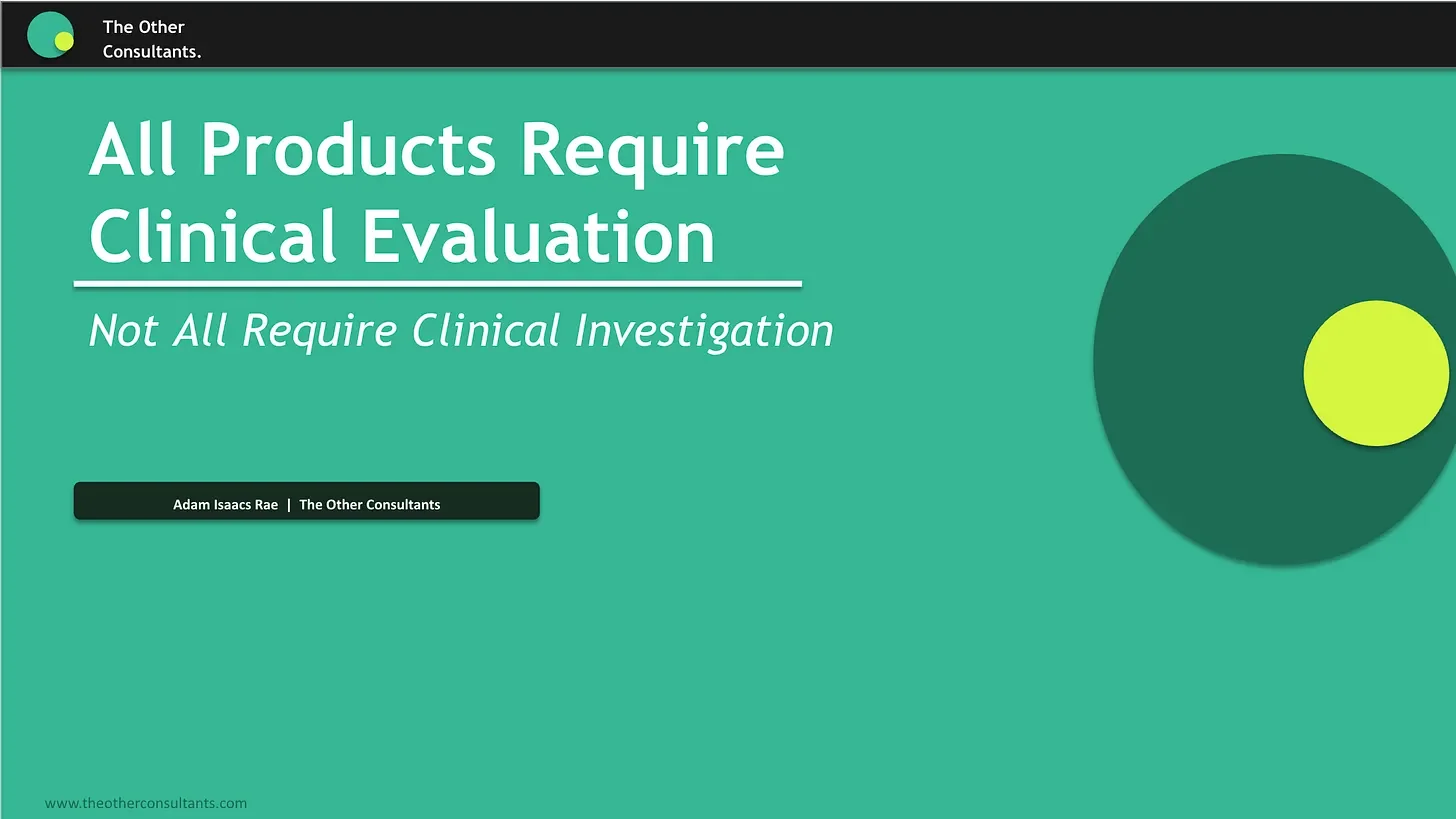
On Monday I had the privilege of speaking at the Innovation and Regulation: A Medical Device Dialogue event a the University of Glasgow. The talk was titled All Products Require Clinical Evaluation — Not All Require Clinical Investigation, and I want to share the core thread of it here for those who couldn’t make it. Before you say it, yes I know that IVDs have performance evaluation instead.
The distinction that trips people up
There’s a fundamental misunderstanding that surfaces regularly in early-stage device development: the conflation of clinical evaluation with clinical investigation. They’re not the same thing, and the regulatory consequences of treating them as interchangeable are significant.
Clinical evaluation is mandatory. Under EU MDR Article 61(1), every medical device — regardless of risk class, novelty, or technology type — requires a clinical evaluation. It is a continuous lifecycle activity, not a one-time document exercise. It uses scientifically sound methods to assess clinical and non-clinical data to verify safety, clinical performance, and clinical benefit.
Clinical investigation, on the other hand, is not automatically required. It only becomes necessary when existing clinical evidence is insufficient to support the benefit-risk conclusion — and that gap is identified through the clinical evaluation process itself.
The question hierarchy that determines your route
The decision of whether a clinical investigation is needed isn’t arbitrary. It flows from a structured set of questions:
Is your device well-established technology (WET) under Article 61(6)? If yes, a literature-only clinical evaluation route may be appropriate — but you still need a CER and a proportionate PMCF plan.
If not, can you demonstrate equivalence to another device under Article 61(3) and MDCG 2021-6? Equivalence requires justification across technical, biological, and clinical characteristics.
If neither applies, does existing clinical evidence demonstrate sufficient safety and clinical performance for your device? If yes, you proceed to a benefit-risk determination. If no — that’s when Article 61(4) or 61(10) applies, and a clinical investigation needs to be planned under ISO 14155.
What “sufficient” actually means
MEDDEV 2.7/1 Rev 4 defines sufficient clinical evidence as an amount and quality of clinical evidence to guarantee the scientific validity of the conclusions. That’s the bar. It’s proportionate to the device and its claims, but it’s the manufacturer’s job to identify, specify, and justify what that level is — against the relevant General Safety and Performance Requirements.
The new standard on the horizon
One slide I spent some time on was ISO/DIS 18969, the first dedicated ISO standard for clinical evaluation of medical devices. Voting closed on 9 March 2026 and publication is expected within the next six months. It maps directly to EU MDR Annex XIV via Annex ZA, and when it lands it will supersede MEDDEV 2.7/1 Rev 4 and IMDRF N56 as the primary reference.
A few things worth flagging now so you’re not caught off guard:
Clinical evaluation planning under 18969 is intended to run in parallel with design and development from the very start, not bolted on later. The benefit-risk profile assessment (§9.4) becomes a formal three-step requirement. Digital evidence — AI outputs, real-world data, computational models — is formally recognised. And perhaps most practically, the scope of alternatives you must compare against expands: you need to evaluate non-medical alternatives, not just similar devices.
The Glasgow scene
I also want to say — without being too sentimental about it — that what is happening in Glasgow around medical devices right now is genuinely worth paying attention to. The event brought together a strong mix of academic, clinical, regulatory, and industry perspectives. If you are developing a device and you’re not tapped into that network, you’re leaving value on the table.
Thank you to Pamela Sandu for the invitation and to everyone who contributed to the discussions on the day.